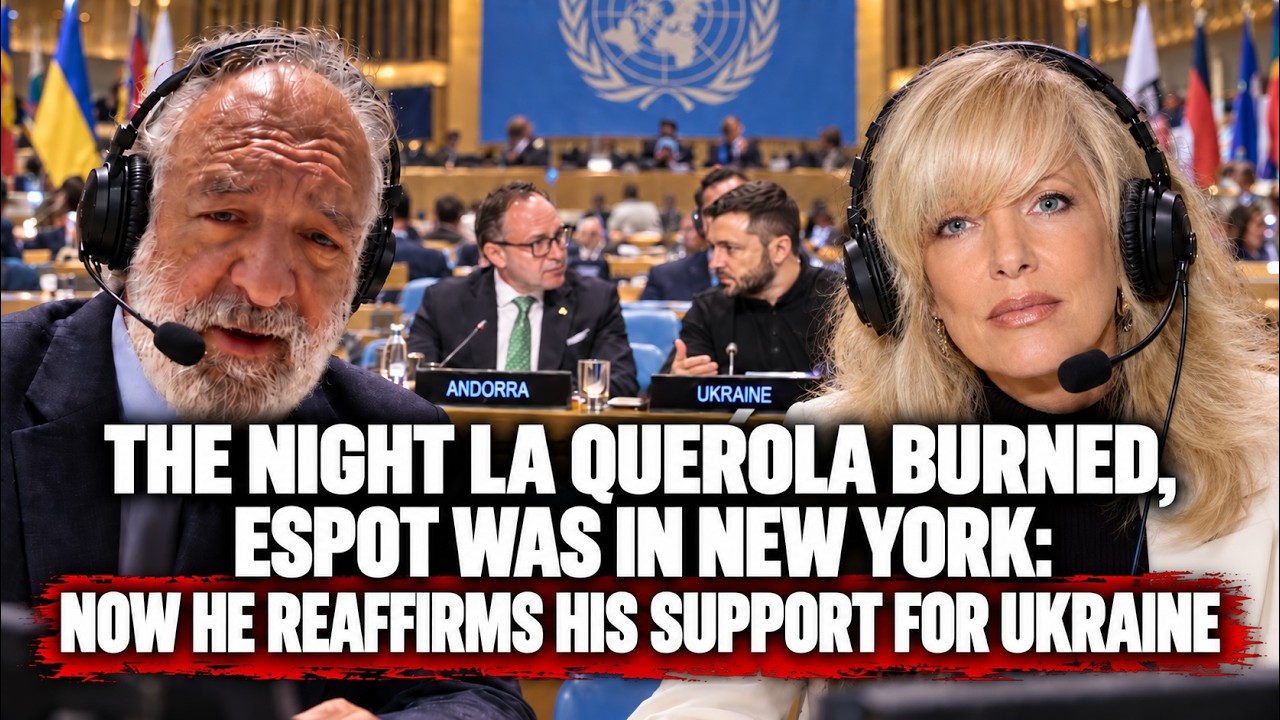
Texte original publié par No es época para tontos.
What happens when political criticism is no longer answered with arguments, but translated into the language of corruption, criminal liability and prosecution?
This investigation begins with a dispute in Andorra and expands into a much larger European question: where is the line between protecting society from genuine crime and building institutions capable of intimidating, identifying or restricting lawful political speech?
The starting point is the September 2026 interview with opposition leader Cerni Escalé. The programme reconstructs, step by step, what Escalé actually said, how the interviewer reformulated his comments, how a media headline interpreted them, and how politicians Jordi Jordana and Maria Martisella later introduced much heavier concepts such as corruption, enrichment, prevarication and the Prosecutor’s Office. The central legal question is simple: can a political judgment about interests and influence be transformed into a criminal accusation that the original speaker never actually made?
From there, the analysis moves into European human-rights law and the landmark Lingens v. Austria judgment. The distinction between statements of fact and value judgments becomes crucial. A factual allegation — for example, accusing someone of taking a specific bribe — can be proved or disproved. A political judgment such as saying that a government serves elite interests belongs to a different legal category and enjoys strong protection within democratic debate.
The programme also examines the institutional significance of Jordi Jordana’s extensive legal background as a former batlle, president of the Batllia and practising lawyer. The issue is not his age or presumed motives, but the degree of legal precision reasonably expected when highly specific criminal terminology is introduced into an ordinary political dispute.
Another contradiction is explored: when Andorran head of government Xavier Espot publicly argued that opposition politicians were not prepared to govern, those statements were treated as political opinions. The investigation asks whether the same tolerance is being applied when harsh judgments travel in the opposite direction.
The focus then widens dramatically.
The episode examines the debate surrounding communications offences in England and Wales, where more than 12,000 arrests were recorded in 2023 under laws dealing with malicious or offensive communications. It also stresses an essential qualification: those figures include genuine threats, harassment and other conduct that a democratic state has a legitimate duty to prosecute. The deeper legal problem is the potential ambiguity of categories such as “grossly offensive”, “annoyance” or “needless anxiety”.
From Britain, the investigation moves to Germany, examining Friedrich Merz’s comments about anonymity and “free speech”, and then to Brussels, where the language of disinformation, foreign interference, democratic resilience and “cognitive warfare” raises further questions about how political risk is defined and who has the authority to define it.
Finally, the programme examines age verification, digital identity and European digital wallets. Protecting minors online is recognised as a legitimate objective. The concern explored here is structural: infrastructure created for one legitimate purpose can later acquire additional functions. The democratic question is therefore not only what a system is designed to do today, but what it could be authorised to do tomorrow.
This is not an argument against criminal law, regulation or public safety. It is an argument for legal certainty, proportionality, judicial oversight, institutional neutrality and freedom of political expression.
Justice should investigate actual crimes. Parliaments should debate policy. Journalists should investigate facts. Citizens should judge political arguments.
The real test of a democracy is not whether it can suppress criticism. It is whether its institutions can withstand criticism without reflexively translating disagreement into the language of crime or surveillance.